
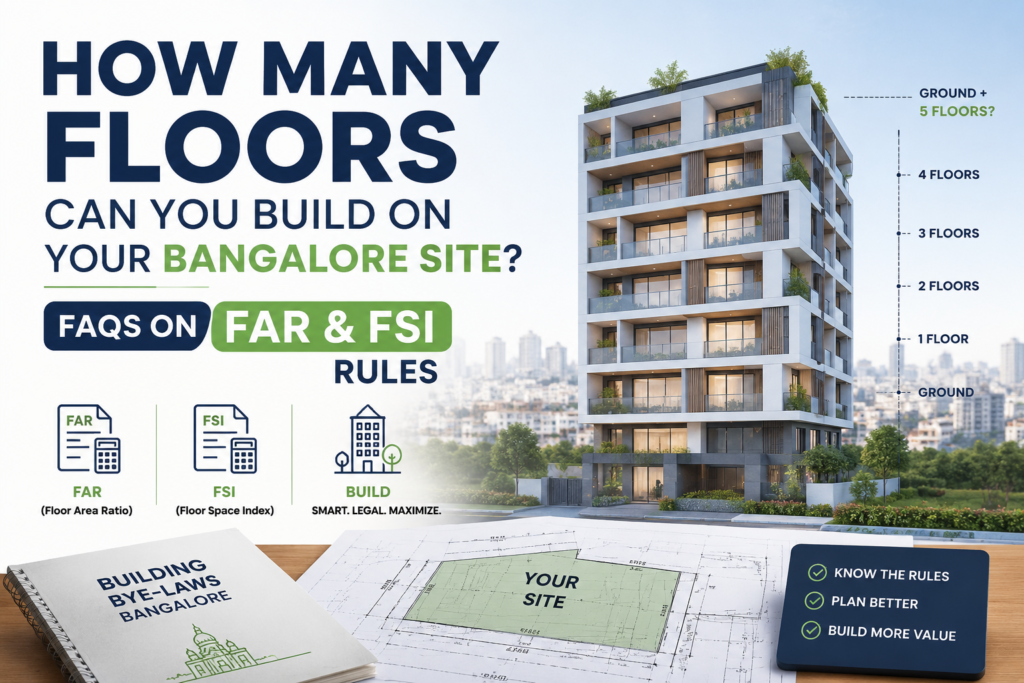
Planning to build in Bangalore? Before you even sketch a floor plan, there’s one number that controls everything: your FAR — the Floor Area Ratio. It decides how much you can build, how tall you can go, and ultimately how much your property is worth as a development opportunity.
Yet most property owners in Bangalore — from first-time homebuilders in Whitefield to experienced developers in Hebbal — get blindsided by FSI and FAR rules. They buy a site expecting to build four floors, only to discover zoning bylaws cap them at two. Or they leave valuable buildable area on the table simply because they didn’t know to ask.
This guide breaks it all down: what FAR and FSI mean, how the BBMP and BDA set the rules in Bangalore, and what it practically means for your site.
What Is FAR and FSI? (And Are They the Same Thing?)
FAR (Floor Area Ratio) and FSI (Floor Space Index) refer to the same concept. FSI is the term historically used in Karnataka and most of South India, while FAR is more common in North India and international planning literature. In Bangalore’s BBMP and BDA documents, you’ll see both used interchangeably.
The formula is simple:
FSI = Total Built-Up Area ÷ Plot Area
So if your site is 2,400 sq ft and the applicable FSI is 2.25, the maximum total floor area you can build is:
2,400 × 2.25 = 5,400 sq ft
That 5,400 sq ft can be distributed across however many floors — subject to height restrictions, setback rules, and parking requirements. More on those below.
Who Regulates FSI in Bangalore?
Bangalore has two primary planning and development authorities:
- BBMP (Bruhat Bengaluru Mahanagara Palike) — Governs building approvals within the Bruhat Bengaluru core municipal limits.
- BDA (Bangalore Development Authority) — Oversees BDA-approved layouts and select development zones.
- BMRDA (Bangalore Metropolitan Region Development Authority) — Covers areas outside BBMP limits in the larger Bangalore Metropolitan Region.
The applicable FSI for your site depends on which authority has jurisdiction and which zoning category your plot falls under. This is defined in the Revised Master Plan (RMP 2031), Bangalore’s long-term spatial planning document.
FSI Limits in Bangalore: Zone-Wise Breakdown
Under the Revised Master Plan 2031 and BBMP bylaws, FSI varies primarily based on road width and zone classification. Here’s a simplified overview:
Residential Zones (R1 & R2)
| Road Width Abutting the Plot | Permissible FSI |
|---|---|
| Up to 9 metres (30 ft) | 1.75 |
| 9 to 12 metres (40 ft) | 2.25 |
| 12 to 18 metres (60 ft) | 2.50 |
| Above 18 metres (60 ft+) | 2.75 to 3.25 |
Commercial Zones
Commercial zones typically allow higher FSI — often 3.25 to 4.0 depending on road width — to maximize land use in high-activity areas.
Mixed-Use Zones
Mixed-use zones allow FSI in the 2.5 to 3.25 range, with additional incentive FSI available for projects incorporating affordable housing, green building features, or public amenities.
Important: These are indicative figures. Your actual permissible FSI must be confirmed from your BBMP sanctioned plan or a qualified architect with access to the latest bylaws. Rules are periodically revised.
What Is Incentive FSI?
Beyond the base FSI, Bangalore’s bylaws allow incentive (additional) FSI for certain conditions:
- Green building certification (IGBC/GRIHA rated buildings)
- Affordable housing components in larger developments
- Underground parking provision (avoids consuming built-up area on upper floors)
- Heritage conservation in notified heritage zones
- Transit Oriented Development (TOD) zones near Metro corridors
In TOD zones — typically within 500 metres to 1 km of a Metro station — FSI can be as high as 4.0 to 5.0, making these among the most valuable development corridors in Bangalore.
How Many Floors Can You Actually Build?
FSI tells you how much you can build; height restrictions and setbacks tell you how tall you can go and where the building can sit on your plot.
Height Limits
Ground + 3 upper floors (G+3) is common for residential plots under 1,200 sq ft in width-restricted roads. Larger plots and wider roads permit taller construction, often G+4 to G+9 in residential zones, with commercial zones allowing even more.
All buildings above 15 metres (roughly G+4) require NOC from the Airports Authority of India (AAI) if within the Obstacle Limitation Surface zone around Kempegowda International Airport. This is relevant for large parts of North Bangalore.
Buildings above 18 metres require a fire NOC from the Karnataka State Fire and Emergency Services.
Setback Requirements
You cannot build right up to the property boundary. BBMP requires mandatory setbacks — clear open space between your structure and the plot edges. These vary by plot size but typically range from 1.5 to 3 metres on front and rear, and 1 to 2 metres on sides. Setbacks reduce your effective buildable footprint, which in turn limits how many floors are practically viable.
Practical Floor Count Example
Suppose you have a 30 × 40 ft (1,200 sq ft) site on a 40 ft wide road in a residential zone.
- Applicable FSI: 2.25
- Maximum built-up area: 1,200 × 2.25 = 2,700 sq ft
- After setbacks, your floor plate might be approximately 700–800 sq ft per floor
- Practical floors: 2,700 ÷ 750 = ~3.5 floors, so realistically G+3 (ground + 3 upper floors)
What Is Not Counted in FSI?
Not all constructed area counts toward your FSI calculation. Exemptions typically include:
- Stilt/parking floor (subject to conditions)
- Open terrace areas (up to a percentage)
- Lift lobbies and stairwells (partially excluded in some bylaws)
- Basement parking (excluded if purely for parking use)
- Service areas and utility shafts
Understanding these exemptions can meaningfully increase the usable floor area you can legally build.
Before You Buy or Build: Key Checks
If you’re purchasing a site or commissioning a building plan in Bangalore, verify the following:
- Which authority has jurisdiction — BBMP, BDA, or BMRDA?
- Zoning classification — Residential, commercial, mixed-use, or industrial?
- Road width abutting the site — Determines your base FSI
- Whether the area falls under TOD zone — Significantly higher FSI may be available
- Height restrictions — AAI, fire NOC, and local bylaws
- Any heritage or forest buffer restrictions — Can override standard FSI norms
- Existing encumbrances or BBMP violations on the property
FAQs on FAR & FSI Rules in Bangalore
Q1. What is the maximum FSI in Bangalore for a residential plot? For residential plots in BBMP limits, the maximum base FSI is typically 2.75, applicable to plots abutting roads wider than 18 metres. In TOD zones near Metro stations, FSI can go up to 4.0 or higher with incentive FSI.
Q2. Does FSI include parking area? Generally, stilt and basement parking areas are excluded from FSI calculations, provided they are used exclusively for parking. This is a significant benefit for developers as it doesn’t eat into your buildable quota.
Q3. Can I get extra FSI by paying a premium? Yes — Bangalore’s planning framework allows purchase of Transferable Development Rights (TDR) and payment of a Development Charges premium to avail additional FSI beyond the base limit in eligible zones. Consult a licensed architect or planner for the current mechanism.
Q4. Is FSI the same across all of Bangalore? No. FSI varies by jurisdiction (BBMP vs. BDA vs. BMRDA), zoning category, and road width. A plot in an older residential layout on a narrow lane will have a lower FSI than a similar-sized plot near a Metro corridor. Always verify site-specifically.
Q5. What happens if I build beyond the permitted FSI? Unauthorized construction beyond permissible FSI is treated as an illegal structure under BBMP bylaws. It can attract demolition orders, heavy penalties, and make your property non-bankable (banks won’t provide loans against unauthorized floors). Regularization, where available, comes with steep fees.
Q6. How do I check the FSI for my specific plot? The most reliable way is to consult a BBMP-registered architect who can access the zoning certificate and applicable bylaws for your specific plot. You can also check your site’s zone classification on the BDA’s RMP 2031 map available on the BDA website or at their offices.