
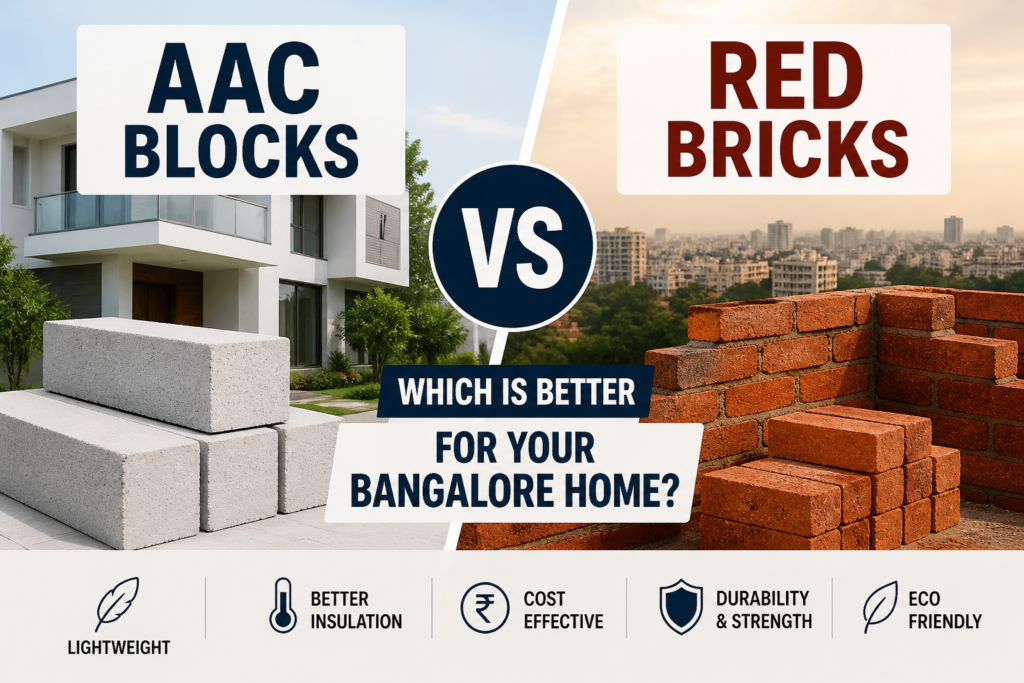
Building a home in Bangalore is one of the most significant investments you’ll make. And in 2026, one decision that trips up nearly every homeowner and builder is the choice between AAC blocks (Autoclaved Aerated Concrete) and the time-tested red clay bricks.
Both materials have their loyalists. Old-school contractors often swear by red bricks; progressive builders are rapidly shifting to AAC. But what does the data — and Bangalore’s specific climate, BBMP regulations, and construction landscape — actually tell us?
This guide cuts through the noise with a detailed, side-by-side comparison so you can make the right call for your project.
AAC Blocks
Modern, Lightweight & Sustainable
Factory-manufactured blocks made from fly ash, cement, lime, and aluminium powder. Cured in high-pressure steam ovens for uniform quality.
Red Clay Bricks
Traditional, Proven & Widely Available
Kiln-fired clay bricks used in Indian construction for centuries. Locally sourced across Karnataka, familiar to all masons and contractors.
1. Structural Strength & Load Bearing
AAC blocks typically have a compressive strength of 3–5 N/mm², while standard red bricks range from 3.5–7 N/mm². On paper, red bricks win the raw strength comparison — but this rarely matters for residential construction in Bangalore.
Most homes in Bangalore follow an RCC (Reinforced Cement Concrete) framed structure, meaning the columns and beams bear the structural load — not the walls. In this setup, AAC blocks perform on par with red bricks for all practical purposes. For load-bearing structures (rare in modern urban Bangalore), red bricks or denser AAC grades are preferable.
Bangalore context: Most G+3 residential buildings under BBMP jurisdiction use RCC frames. AAC blocks rated 4 N/mm² are fully compliant and widely approved.
2. Cost Comparison (Bangalore, 2026)
Material cost is often the first thing homeowners ask about. Here’s a realistic breakdown for Bangalore in 2026:
| Cost Factor | AAC Blocks | Red Bricks | Winner |
|---|---|---|---|
| Material cost per cubic ft | ₹60–75 | ₹40–55 | Red Brick |
| Mortar consumption | Very low (thin-bed) | High (thick joints) | AAC Block |
| Plastering thickness | 6–10 mm | 12–20 mm | AAC Block |
| Labour cost (per sq ft wall) | ₹25–35 | ₹35–50 | AAC Block |
| Dead load savings (structural) | Saves 10–15% on RCC | None | AAC Block |
| Overall project cost impact | Saves ₹8–15/sq ft | Baseline | AAC Block |
While AAC blocks cost more per unit, the savings in mortar, plaster, labour, and RCC design often make them cheaper overall on a project basis — by 5–10% in most Bangalore residential builds.
3. Thermal Comfort — Critical for Bangalore’s Climate
Bangalore’s climate in 2026 is increasingly unpredictable — summers push past 35°C and the city’s urban heat island effect is more pronounced than ever. Thermal performance of your walls directly impacts both comfort and your electricity bills.
0.24AAC thermal conductivity (W/mK) — excellent insulation
0.81Red brick thermal conductivity (W/mK) — 3× more heat transfer
~25%AC cost savings in AAC homes vs red brick (est.)
AAC’s cellular structure traps millions of tiny air pockets, making it a natural insulator. Homes built with AAC stay noticeably cooler in summer and warmer during Bangalore’s mild winters. For the city’s growing number of top-floor apartments and independent villas, this is a game-changer.
4. Construction Speed & Ease
Time is money in Bangalore’s booming construction scene. AAC blocks are typically 8–10x the volume of a standard red brick. This means fewer blocks to lay, faster wall completion, and fewer joints — reducing overall construction time by 20–30% for the walling phase.
AAC blocks also have precise, factory-controlled dimensions, which means straighter walls, easier electrical and plumbing chasing, and less reliance on the skill level of individual masons. Red bricks, being handmade in many Karnataka kilns, vary in size and density — requiring more skilled masonry to achieve a quality finish.
Pro tip for Bangalore builds: Skilled AAC masons are now widely available in Whitefield, Sarjapur, and Hebbal corridors. Expect a slightly longer search in Anekal or peripheral areas.
5. Pros & Cons at a Glance
AAC Blocks
Advantages
- Superior thermal & sound insulation
- Lightweight — reduces structural load
- Faster construction speed
- Uniform dimensions & quality
- Environmentally friendlier (uses fly ash)
- Fire resistant up to 1200°C
- Pest & mould resistant
Disadvantages
- Higher upfront material cost
- Requires specific AAC adhesive mortar
- Brittle — needs careful handling
- Fewer experienced masons in rural zones
- Absorbs water if unsealed improperly
Red Clay Bricks
Advantages
- Lower unit material cost
- Every mason knows how to lay them
- Robust & durable in load-bearing use
- Familiar to all contractors in Karnataka
- Good compressive strength
Disadvantages
- Poor thermal insulation
- Heavier — increases structural costs
- Inconsistent sizing from local kilns
- High water absorption
- Significant environmental impact (topsoil destruction, kiln emissions)
- Slower construction pace
6. Environmental Impact — A Growing Concern
With Bangalore’s construction boom showing no signs of slowing, the environmental footprint of building materials matters more than ever. Red brick manufacturing destroys fertile topsoil and burns significant fossil fuels in kilns. Many Karnataka brick kilns also face increasing regulatory scrutiny.
AAC blocks, by contrast, use fly ash — an industrial waste product from thermal power plants — diverting it from landfills. The autoclaving process is more energy-efficient than kiln firing. For builders seeking green building certifications (IGBC or GRIHA ratings in Bangalore), AAC is the clear choice.
7. Which Should You Choose? A Decision Guide
| Your Situation | Recommended Choice |
|---|---|
| RCC framed structure, G+1 to G+4 residential | AAC Blocks |
| Top floor or terrace-level rooms (heat gain concern) | AAC Blocks |
| Tight budget, experienced local crew, no AC planned | Red Bricks |
| Load-bearing structure in older neighbourhood | Red Bricks (denser grade) |
| IGBC / green building certification target | AAC Blocks |
| Faster project timeline (monsoon approaching) | AAC Blocks |
| Low-rise compound walls or boundary walls | Red Bricks |
The Bottom Line
For most new residential construction in Bangalore in 2026, AAC blocks are the smarter choice. They deliver better thermal comfort for the city’s warming climate, faster build times, and comparable or lower total project costs — despite higher unit prices.
Red bricks still have a role — particularly for budget-first projects with experienced traditional crews, compound walls, or situations where AAC-trained masons aren’t available.
If you’re building a home you plan to live in for decades, the long-term savings in cooling costs, the superior living comfort, and the reduced structural load make AAC blocks a compelling investment.
Best for AAC: Villas Apartments Green builds Fast timelines
Best for Red Brick: Budget builds Boundary walls Load-bearing
Frequently Asked Questions
Are AAC blocks approved by BBMP for residential construction in Bangalore?
Yes. AAC blocks conforming to IS 2185 Part 3 are fully approved for use in residential construction under BBMP building bylaws. They are widely used across Bengaluru in both individual homes and large apartment complexes. Always ensure your supplier provides BIS-certified AAC blocks.
What is the price difference between AAC blocks and red bricks in Bangalore in 2026?
AAC blocks cost approximately ₹60–75 per cubic foot of wall volume, while red bricks cost ₹40–55. However, when you factor in reduced mortar use, thinner plaster requirements, lower labour costs, and structural savings from reduced dead load, AAC blocks often result in a net saving of ₹8–15 per square foot at the finished wall level.
Do AAC blocks crack easily? How durable are they?
AAC blocks are more brittle than red bricks during transportation and handling, but once properly laid using AAC adhesive mortar, the finished wall is highly durable. They do not crack due to thermal expansion (unlike red brick walls), have no organic material to support fungal growth, and have excellent fire resistance. Durability in Bangalore’s climate is rated at 50+ years when properly installed.
Which is better for sound insulation — AAC or red brick?
AAC blocks significantly outperform red bricks in sound insulation. A 200mm AAC wall can achieve an STC (Sound Transmission Class) rating of 44–46 dB, compared to 42–44 dB for a comparable red brick wall. For homes near Bangalore’s busy arterial roads, airports (near Devanahalli), or high-density zones, AAC’s superior acoustic insulation is a notable advantage.
Can AAC blocks be used for exterior walls in Bangalore’s monsoon climate?
Yes, but proper waterproofing is essential. AAC blocks have higher water absorption than red bricks, so exterior walls must be plastered with a polymer-modified plaster or coated with a water-repellent exterior paint or texture finish. When this is done correctly — which is standard practice for any quality construction — AAC performs excellently through Bangalore’s heavy monsoon seasons.
Will switching to AAC blocks really reduce my electricity bills?
Yes, meaningfully so. Studies and builder feedback from Bangalore suggest that homes built with AAC blocks consume 20–25% less energy for cooling compared to red brick homes of equivalent size. Given Bangalore’s increasingly warm summers and rising electricity tariffs in Karnataka, the savings on air conditioning costs over a decade can easily offset the higher initial cost of AAC blocks.