
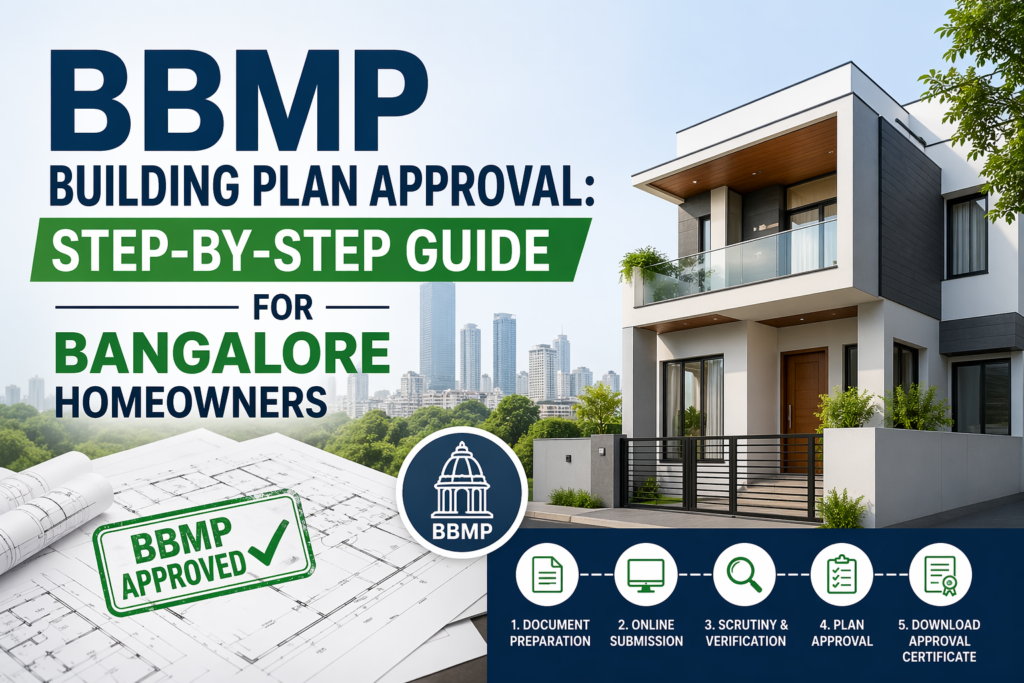
You’ve found the plot. You’ve saved up for years. You’re finally ready to build your dream home in Bangalore.
But before a single brick is laid, there’s one step you absolutely cannot skip — BBMP Building Plan Approval.
Many homeowners treat this as a formality. They’re wrong. Skipping or rushing this step has cost Bangalore homeowners lakhs in penalties, months in delays, and in worst cases — demolition orders on completed structures.
This guide walks you through the entire BBMP building plan approval process in 2026 — what it is, why it matters, every document you need, the step-by-step process, fees, timelines, and the most common mistakes to avoid.
What Is BBMP Building Plan Approval?
BBMP stands for Bruhat Bengaluru Mahanagara Palike — the municipal body responsible for Bangalore’s urban infrastructure, civic services, and city planning.
BBMP Building Plan Approval (also called Building Plan Sanction or Building Permit) is the official legal permission granted by BBMP to construct a residential or commercial building within the Bangalore city limits.
Before issuing this approval, BBMP verifies that your proposed construction complies with:
- Zoning regulations — whether residential construction is legally permitted on your specific plot
- Setback rules — minimum open space required on all sides of the structure
- Floor Area Ratio (FAR) — the maximum total built-up area you are allowed relative to your plot size
- Height restrictions — how many floors you can build based on plot size and road width
- Building bye-laws — Karnataka’s unified construction standards for safety and habitation
Without this approval, your home is legally classified as unauthorised construction — regardless of how well it is built.
Why Is BBMP Plan Approval Mandatory?
This is not optional, and it’s not just bureaucratic red tape. Here is what happens when you build without a valid BBMP building plan approval:
- BBMP can issue a stop-work notice and halt construction at any stage
- Penalties up to ₹1 lakh or more under the Karnataka Municipal Act
- Demolition orders on unauthorised structures — which courts have upheld multiple times
- No Occupancy Certificate (OC) — without which you cannot legally occupy your own home
- Banks refuse home loans or impose additional conditions on properties without approved plans
- Property registration and resale become difficult or impossible
- BWSSB and BESCOM connections (water and electricity) may be denied
In short: building without BBMP approval is not a shortcut — it is a risk that can undo your entire investment.
Who Needs BBMP Building Plan Approval?
You need BBMP building plan approval if you are:
- Building a new residential house within BBMP limits in Bangalore
- Constructing a G+1, G+2, or G+3 structure on your plot
- Adding floors to an existing building
- Making major structural alterations to an existing house
- Converting land use from one category to another
If your plot falls under BDA (Bangalore Development Authority) or BIAPPA jurisdiction instead of BBMP, the approval authority differs — but the importance remains identical.
Quick Check: If your property has an A-Khata (not B-Khata) and falls within the BBMP administrative boundary, you need BBMP building plan approval.
BBMP Zones: Which Zone Does Your Property Fall Under?
BBMP’s jurisdiction is divided into four administrative zones:
| Zone | Areas Covered |
| East Zone | Whitefield, Marathahalli, Bellandur, Varthur |
| West Zone | Rajajinagar, Yeshwanthpur, Peenya, Nagarbhavi |
| South Zone | Banashankari, Jayanagar, Koramangala, BTM Layout |
| North Zone | Hebbal, Yelahanka, Ramamurthy Nagar, Thanisandra |
Your zone determines which BBMP ward office handles your application and which Assistant Executive Engineer (AE) conducts the site inspection.
Key BBMP Building Bye-Laws You Must Know Before Designing
Understanding a few critical rules before your architect begins drawing saves costly redesigns later.
1. Floor Area Ratio (FAR)
FAR determines how much total built-up area you can construct on your plot. In BBMP residential zones, FAR typically ranges from 2.0 to 3.0, depending on road width and location. A higher FAR does not eliminate setback or parking requirements. Many owners lose an entire floor due to incorrect FAR assumptions — verify this before finalising your design.
2. Setbacks
Setbacks are mandatory open spaces from your plot boundaries on all sides.
- Front setback: 4.5 metres (6 metres in some zones or wider roads)
- Side and rear setbacks: Vary based on plot size and number of floors
- Corner plots have additional requirements
3. Height and Number of Floors
The number of floors permitted depends on your plot size and the width of the road in front. For buildings beyond a certain height, fire department clearance becomes mandatory. Your architect must confirm permissible height before the design is finalised.
4. Parking Requirements
BBMP bye-laws mandate parking provisions based on built-up area. Failing to account for parking in your plan is one of the most common reasons for rejection.
5. Rainwater Harvesting
Rainwater harvesting pits are mandatory for all new residential constructions. This must be shown in your submitted plan.
Documents Required for BBMP Building Plan Approval
Getting your documentation right is the single most important factor in avoiding delays. Most rejections happen not because of structural violations — but because of incomplete or incorrect paperwork.
Land Ownership Documents
- Registered Sale Deed / Title Deed (Certified Copy)
- Latest Khata Certificate and Khata Extract — A-Khata is mandatory (e-Khata is required from July 2025 onwards on the Greater Bengaluru Authority portal)
- Latest Property Tax Paid Receipt — unpaid tax will stall your application
- Encumbrance Certificate (EC) — confirms no registered mortgages or disputes on the property
- Revenue Sketch / Survey Sketch from the Sub-Registrar’s office
- Land Conversion Order (if your plot was previously agricultural land)
Architectural and Structural Drawings
- Detailed Architectural Drawings: Site Plan, Floor Plans, Elevations, and Sections — prepared and digitally signed by a BBMP-registered licensed architect
- Structural Drawings and Stability Certificate — signed by a registered structural engineer (mandatory for multi-storey buildings)
- Pre-DCR (Development Control Regulations) file in CAD format — uploaded by your architect to the OBPAS portal
- Soil Test Report — mandatory for taller or larger structures
Owner’s Personal Documents
- Owner’s Aadhaar Card and PAN Card
- Passport-size photographs of the owner
- Affidavits and Undertakings — including Indemnity Bond, Schedule II and III forms, signed by both the owner and the registered professionals
NOCs (No Objection Certificates) — Where Applicable
- BWSSB — for water supply and sewerage connectivity
- BESCOM — for electrical load requirements on larger buildings
- Fire Department — mandatory for buildings above a certain height
- Airport Authority of India (AAI) — if your plot falls within the flight path zone
- BDA — if layout formation falls under BDA jurisdiction
Pro Tip: Collect your Encumbrance Certificate covering the last 15–30 years. Any gap or dispute in ownership history will be flagged during scrutiny.
Step-by-Step BBMP Building Plan Approval Process (2026)
Step 1: Verify Your Land and Zoning Status
Before anything else, confirm:
- Your plot is inside BBMP limits and has an active A-Khata
- The land use classification permits residential construction (check the Revised Master Plan 2031 or RMP-2031)
- There are no encumbrances, lake buffer restrictions, or road widening notifications affecting your plot
This step alone eliminates a significant percentage of later complications.
Step 2: Hire a BBMP-Registered Architect
You cannot submit a BBMP building plan approval application directly as an owner. The application must be prepared and submitted by a licensed architect or engineer registered with BBMP.
Your architect will:
- Design your house plan in full compliance with BBMP bye-laws (setbacks, FAR, height, parking, rainwater harvesting)
- Prepare all required drawings in the correct format
- Create the Pre-DCR CAD file for upload to the OBPAS portal
- Sign and certify all structural and architectural submissions
Choosing an architect who is familiar with your specific BBMP ward’s requirements significantly reduces the risk of rejection.
Step 3: Online Submission via BBMP OBPAS
BBMP uses the OBPAS (Online Building Plan Approval System) portal for digital submission. Your architect will:
- Register and log in to the OBPAS portal (bpas.bbmpgov.in)
- Upload the Pre-DCR file (building plan in CAD format)
- Upload all property and identity documents
- Submit the application and receive an acknowledgment number
For smaller residential plots, the Nambike Nakshe (Trusted Map) scheme provides a faster track — where plans are self-certified by the licensed architect and processed more quickly, provided all bye-laws are followed precisely.
The OBPAS system uses automated AI-driven checks that immediately flag violations in setbacks, FAR, and height — before human review begins. If violations are detected at this stage, the plan is returned for correction.
Step 4: Fee Payment
Once the plan clears initial digital scrutiny, the system generates a demand note. All payments are made online.
Fee components include:
- Scrutiny Charges: ₹1–2 per sq.ft of built-up area
- Development Charges: ₹200–300 per sq.m
- Total Range: Typically ₹25,000 to ₹1,50,000 for residential plots, depending on plot size, zone, and number of floors
A fast-track option is available for smaller residential buildings (up to 2,000 sq.m) at a 25% premium on standard fees — saving significant time for straightforward projects.
Step 5: Site Inspection by BBMP Engineer
After the online submission and fee payment, a BBMP Assistant Executive Engineer (AE) and Assistant Director of Town Planning (ADTP) visit your site to verify:
- Actual plot boundary and dimensions match the submitted plan
- Road width in front of the plot (which determines FAR and setbacks)
- Any existing structures or encroachments
- Access and drainage conditions
This inspection typically occurs within 5–7 working days of submission.
Step 6: Auto DCR Scrutiny and Plan Review
The case worker generates an Auto DCR (Development Control Regulations) document that scrutinises your uploaded building plan against all applicable bye-laws. This is where violations, if any, are formally identified.
If observations or objections are raised, your architect must revise and resubmit the corrected plan. Once all observations are addressed, the file moves to final review.
Step 7: Final Sanction and Building Licence Issuance
If the inspection report is satisfactory and all documents are verified, BBMP issues:
- Building Plan Approval Certificate (digitally signed)
- Building Licence (also called Plan Sanction Letter)
Under the Sakala Mission, if BBMP does not raise any objection within 30 working days, the plan receives deemed approval — a significant protection for homeowners.
The approval is valid for 3 years from the date of issue. If construction has not commenced within this period, renewal is required.
BBMP Approved House Plans: What the Sanction Document Contains
Your BBMP approved house plans and sanction document will include:
- Sanctioned floor plans with BBMP stamp and digital signature
- Approved FAR and built-up area calculations
- Setback dimensions confirmed as per bye-laws
- Number of floors sanctioned
- Conditions and special notes (if any)
- Validity period of the approval
Keep this document safe. You will need it during every stage of construction, for your Commencement Certificate (CC), Occupancy Certificate (OC), and future property transactions.
After Approval: What Comes Next?
Getting BBMP building plan approval is the beginning, not the end, of the compliance journey.
Commencement Certificate (CC): Before you begin construction, you must apply for a CC from BBMP, confirming that work is starting as per the approved plan.
Construction Stage Inspections: BBMP engineers may inspect at plinth, slab, and completion stages to ensure construction matches the sanctioned plan.
Occupancy Certificate (OC): After construction is completed, you must obtain an OC from BBMP. This confirms that the building matches the approved plan and meets all safety and habitability standards. Without an OC, the building is legally considered unauthorised for occupation — affecting home loans, resale, water connections, and electricity meters.
BBMP Building Plan Approval Timeline: What to Realistically Expect
| Stage | Typical Duration |
| Document preparation and architectural drawings | 2–3 weeks |
| Online submission and fee payment | 1–2 days |
| Auto DCR check and initial scrutiny | 24–48 hours |
| Site inspection by BBMP engineer | 5–7 working days |
| Plan review and observations (if any) | 7–15 days |
| Final sanction issuance | 5–10 working days |
| Total (complete documents, no major violations) | 30–45 working days |
Delays are almost always caused by documentation errors, outstanding property tax dues, violations detected in the plan, or incorrect land use classification — not by BBMP processing time.
Common Mistakes That Lead to Rejection or Delay
1. B-Khata instead of A-Khata If your property has a B-Khata, it means it is not officially entered in BBMP’s revenue records. BBMP will not process a building plan application without an A-Khata. Conversion is a separate process that takes time.
2. Unpaid Property Tax Even a small outstanding tax amount can halt your application. Clear all dues before submitting.
3. Incorrect FAR Calculation Many homeowners and even some architects make errors in FAR calculations — often trying to maximise floors without accounting for parking, staircase cores, or setback adjustments. This results in rejection.
4. Violating Setbacks Reducing a setback by even 0.6 metres — as happened in a documented North Bangalore case — can lead to plan rejection, BBMP penalties, and forced reconstruction costing over ₹12 lakhs.
5. Agricultural Land Without Conversion Order If your plot was originally agricultural land, a land use conversion order is mandatory before applying for building plan approval. Submitting without this document leads to immediate rejection.
6. Plans Not Prepared by a BBMP-Registered Professional BBMP will not accept plans drawn or signed by an architect or engineer who is not registered with them. Always verify your professional’s BBMP registration before engagement.
7. Missing NOCs Forgetting required NOCs — especially BWSSB and fire department clearances for certain projects — is a common reason for incomplete applications.
BBMP Plan Approval vs BDA Plan Approval: Which One Applies to You?
| Criteria | BBMP | BDA |
| Authority | Bruhat Bengaluru Mahanagara Palike | Bangalore Development Authority |
| Jurisdiction | Core Bangalore city areas | BDA-formed layouts (Dollars Colony, Banashankari, JP Nagar, etc.) |
| Khata Type | A-Khata (BBMP) | BDA Khata |
| Portal | OBPAS / bpas.bbmpgov.in | BDA Online Portal |
| Typical Timeline | 30–45 working days | 30–60 working days |
If you are unsure which authority governs your plot, check your Khata Certificate or consult your construction company or architect before proceeding.
How CosmicNest Helps You Navigate BBMP Approval
At CosmicNest, we understand that the BBMP approval process can feel overwhelming — especially for first-time homebuilders. That is why we offer complete end-to-end support for BBMP building plan approval as part of our residential construction service in Bangalore.
Our team assists with:
- Zoning and land use verification before design begins
- Connecting you with BBMP-registered architects who know ward-level rules
- Document checklist and preparation to avoid incomplete submissions
- Coordinating with BBMP engineers during site inspection
- Tracking your application and resolving observations quickly
- Obtaining your Commencement Certificate and Occupancy Certificate after construction
With 130+ completed residential projects across Bangalore and over a decade of construction experience, we have guided homeowners through BBMP approvals across all four BBMP zones. You focus on designing your dream home — we take care of the paperwork.
Frequently Asked Questions
Q: Can I apply for BBMP building plan approval myself? No. Applications must be submitted through a BBMP-licensed architect or engineer. You cannot submit directly as an owner.
Q: What is the cost of BBMP building plan approval for a typical residential plot? For most residential plots in Bangalore, the total cost ranges from ₹25,000 to ₹1,50,000 depending on plot size, zone, built-up area, and building type.
Q: How long does BBMP plan approval take in 2026? With complete documentation and no major violations, approval typically takes 30–45 working days. The Nambike Nakshe scheme can be faster for smaller plots.
Q: What happens if I build without BBMP approval? Your construction is classified as unauthorised. BBMP can issue stop-work notices, impose penalties, and order demolition. You will also be unable to obtain an Occupancy Certificate, home loan, or permanent utility connections.
Q: Is BBMP approval required for renovation or adding a floor? Yes, for structural changes like adding a floor or extending the building footprint, fresh or amended approval is required. Minor cosmetic repairs generally do not require it.
Q: My plot has B-Khata. Can I still apply? Not directly. You must first convert to A-Khata before applying for BBMP building plan approval.
Q: How long is the BBMP building plan approval valid? The approval is valid for 3 years from the date of issue. Construction must commence within this period, failing which a renewal application is needed.
Conclusion
BBMP building plan approval is the legal foundation on which your dream home is built. Getting it right — with complete documents, a qualified architect, and accurate plans — sets the tone for a smooth, penalty-free construction journey.
In 2026, the process is more digital, faster, and more transparent than ever. But it is also more accountable. Automated scrutiny and tighter audits mean that violations — even small ones — are harder to overlook.
Start with a legal, approved plan. Build with quality. And finish with an Occupancy Certificate that protects your investment for generations.
Planning to build your home in Bangalore? Contact CosmicNest for a free consultation. We handle your BBMP approval process end-to-end — so you can focus on the exciting part: designing your dream home.