
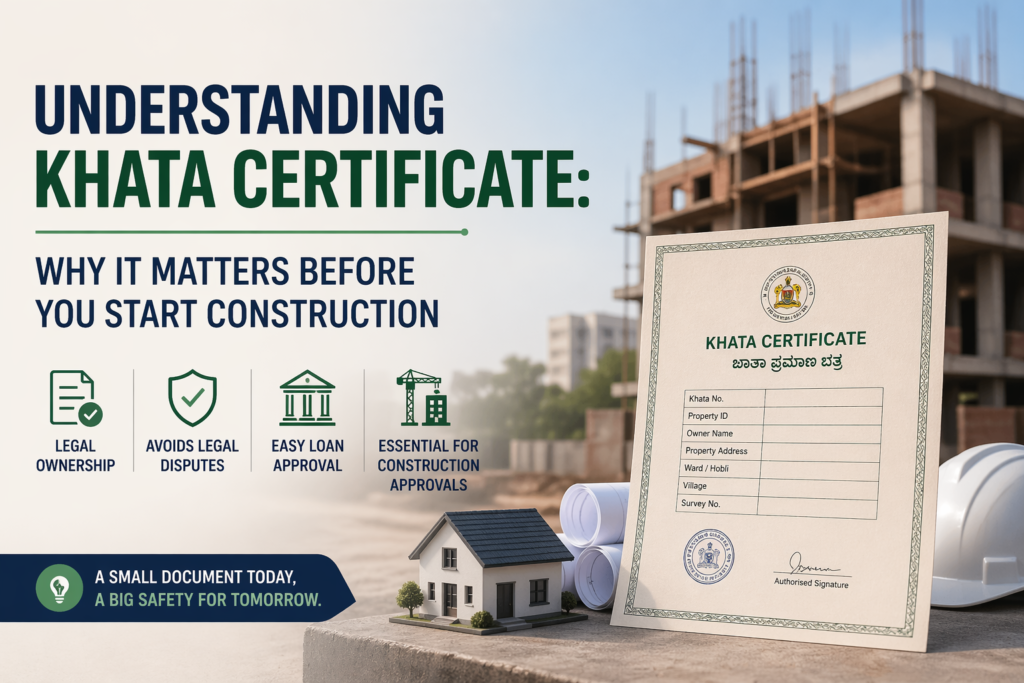
What is a Khata certificate?
A Khata certificate is an official record maintained by the local civic body that lists details of a property such as the owner’s name, property size, location, and assessed tax. It is not the same as a sale deed or title deed, but it does show that your property is “registered” in the municipality’s database for taxation and civic‑service purposes.
In many cities, especially Bengaluru, you also see terms like “A Khata,” “B Khata,” and “E‑Khata,” which indicate different levels of compliance with building bylaws and zoning rules. A Khata properties are generally considered fully legal and tax‑compliant, while B Khata or other unofficial categories may carry restrictions on loans, permits, and services.
Why the Khata matters before starting construction
1. Legal compliance and building approvals
Before issuing building‑plan approval or construction permits, municipal authorities usually check the Khata status of the property. If the land is not in the correct Khata category (for example, meant only for agriculture or outside approved layouts), your construction may be treated as illegal or unapproved.
An active Khata also helps the corporation verify that the property already pays property tax and is in order with earlier dues, which is a prerequisite for new construction or expansion.
2. Property tax and dues clearance
A Khata is the primary document through which the municipality calculates and records your property tax. Starting construction on a property with pending or disputed tax dues can lead to delays, on‑stop notices, or even demolition orders in extreme cases.
By confirming the Khata at the planning stage, you can also clear any outstanding tax, service charges, or betterment levies and avoid future penalties.
3. Access to utilities (water, electricity, sewage)
Most civic bodies link water, electricity, and sewer connections to the Khata registration. Without a valid Khata, you may struggle to get:
- Legal water and sewerage connections for the site.
- Sanctioned electricity connections for temporary site power or permanent supply.
This can delay site‑mobilization, contractor work, and the overall timeline of your project.
4. Loan and financing eligibility
Banks and financial institutions routinely ask for a Khata certificate when you apply for:
- Home loans against the property.
- Construction or renovation loans.
If your property lacks a proper Khata or is only in a non‑compliant category (e.g., B Khata), lenders may refuse or heavily discount the loan. This can make it difficult to fund your construction or force you to depend on costlier, informal finance.
5. Future sale, transfer, and resale value
A clean, up‑to‑date Khata makes property transactions smoother and more attractive to buyers. When you eventually sell:
- Agents, buyers, and developers prefer properties with a clear A Khata (or equivalent) because they are easier to finance and verify.
- Any pending Khata issues or disputes can surface during due‑diligence and either delay the deal or lower the negotiated price.
Types of Khata and which to target
In practice, the exact categories vary by city, but the core idea is the same: some entries are “full‑compliance” and others are “limited‑status.”
- A Khata / Standard Khata
- Property fully compliant with zoning, building bylaws, and tax rules.
- Best choice before starting construction; usually required for building permits, loans, and utilities.
- B Khata / Non‑conforming Khata
- Property appears in municipal records but may violate building norms (e.g., unapproved FSI, illegal layout).
- Often ineligible for loans or extensions; may face future regularization hurdles.
- E‑Khata (electronic Khata)
- Digitally maintained Khata introduced by corporations like BBMP to streamline records and reduce manual work.
- Increases transparency and eases the process of verification and transfer.
As a builder, developer, or homeowner, you should aim to (re)classify your plot to A Khata or its local equivalent before submitting your building‑plan application.
How to check and secure your Khata
Most cities now allow you to:
- Log in to the municipal or corporation portal (e.g., BBMP, BMC, or local municipal corporation).
- Search by property ID, ward number, survey number, or owner name to see existing Khata details.
- Apply for new Khata or Khata transfer online by uploading documents such as sale deed, encumbrance certificate, tax receipts, ID proof, and property photos.
If your property is newly constructed or you have just purchased a plot, you should:
- Verify the existing Khata status and category.
- Ensure the owner’s name matches the registered deed and there are no overlapping or duplicate Khata entries.
- Clear any pending property‑tax dues before applying for construction‑related permissions.
Practical steps before starting construction
To avoid surprises, follow this mini‑checklist before you begin:
- Confirm the exact Khata category (A/B/e‑Khata) with the local municipal office or portal.
- Ensure the Khata is in your name or about to be transferred, and there are no disputes or multiple owners shown.
- Clear any outstanding property‑tax dues or penalties.
- Use the Khata details in your building‑plan application and for applying for water, electricity, and sewage connections.
- If the Khata is non‑compliant (for example, B Khata), consult a local property‑law professional or agent to understand the regularization options before investing heavily in construction.
Why this matters for you personally
If you are planning to build a house, duplex, or commercial structure, skipping Khata verification is like starting a journey without checking whether your vehicle is registered. Down the road, you risk:
- Delayed or rejected building‑plan approvals.
- Higher difficulty in getting loans and selling the property.
- Potential legal or compliance actions if the construction is found to be on non‑compliant land.
By making the Khata certificate a mandatory first step in your construction checklist, you lay a legally sound, finance‑friendly, and future‑ready foundation for your project.You can adapt this text into a blog post by adding your own city‑specific guidelines (for example, “If you’re in Mumbai, check your BMC Khata status online via the BMC portal…”) and including a short FAQ box at the end with questions like “Can I start construction without Khata?” or “How long does Khata regularization take?” for reader engagement.