
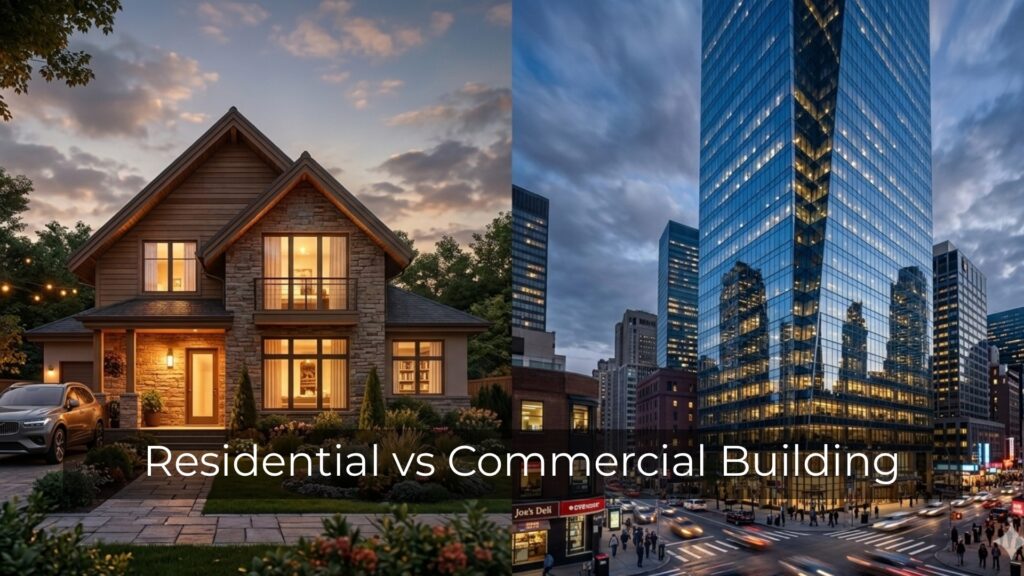
India’s construction industry is on a remarkable growth trajectory. With the sector projected to expand at a CAGR of 9.6% through 2028 and construction output expected to cross INR 36.58 trillion, both residential and commercial segments are booming side by side. Yet for homeowners, investors, and first-time builders, the differences between residential and commercial buildings are often unclear, leading to costly mistakes, permit delays, and poor investment decisions.
Whether you are planning to build your dream home in Bangalore, evaluate a mixed-use investment, or simply understand where your property stands legally and financially, this guide breaks down everything you need to know about residential vs commercial buildings in India, especially in the context of Bangalore’s evolving urban landscape.
1. What Is a Residential Building?
A residential building is any structure primarily designed and used for human habitation. In India, this includes:
• Independent houses and bungalows
• Row houses and villas
• Apartments and multi-storey residential complexes
• Affordable housing units under PMAY (Pradhan Mantri Awas Yojana)
• Gated community layouts
Residential construction focuses on creating comfortable, private living environments with defined spaces like bedrooms, living areas, kitchens, bathrooms, and utility zones. The design priority is occupant comfort, natural light, ventilation, and emotional liveability.
In Bangalore, residential construction is governed primarily by BBMP (Bruhat Bengaluru Mahanagara Palike), BDA (Bangalore Development Authority), and BMRDA (Bangalore Metropolitan Region Development Authority), depending on the property location.
If you are thinking of building a home in Bangalore, start with our comprehensive
If you are thinking of building your own home, explore our Residential Construction services at CosmicNest to understand how the process works from foundation to finish.
2. What Is a Commercial Building?
A commercial building is any structure built for business, trade, or income-generating purposes. Examples include:
• Office complexes and IT parks
• Retail shops, showrooms, and shopping malls
• Hotels, restaurants, and hospitality establishments
• Warehouses and logistics hubs
• Co-working spaces and business centres
Commercial construction prioritises functionality, high footfall capacity, operational efficiency, and return on investment. Design decisions are driven by business logic rather than personal comfort. Open floor plans, large structural spans, high-capacity electrical systems, HVAC infrastructure, and advanced fire safety systems are standard requirements.
Commercial buildings in India also attract more stringent compliance requirements from authorities such as KSPCB (Karnataka State Pollution Control Board), fire safety departments, and airport authority clearances where applicable.
3. Residential vs Commercial Building: A Detailed Comparison
3.1 Purpose and Design Philosophy
Residential buildings are designed around the human experience of living. Privacy, natural light, vastu considerations, neighbourhood character, and family-specific requirements are central to design. In contrast, commercial buildings are designed around productivity, business flow, and maximum space utilisation per square foot.
In Bangalore’s fast-growing tech corridors like Whitefield, Electronic City, and Hebbal, commercial buildings often incorporate smart building technologies, energy management systems, and Grade A specifications to attract corporate tenants.
3.2 Construction Materials and Structural Systems
Residential construction in India typically uses reinforced cement concrete (RCC) frames, brick masonry, and conventional plastering. Premium residences may incorporate AAC blocks, engineered wood, and imported tiles. The construction methodology follows a conventional approach focused on durability, aesthetics, and comfortable livability.
Commercial construction demands more robust structural systems. Steel or concrete frames, curtain wall glazing systems, pre-engineered building (PEB) components, and heavy-duty flooring capable of bearing significant live loads are standard. A commercial warehouse, for example, requires floors designed for forklift traffic, while an office building must accommodate dense electrical cabling, false flooring, and HVAC distribution.
The average residential construction cost in Bangalore ranges from Rs. 1,800 to Rs. 2,500 per square foot. Commercial construction, due to specialised systems and compliance requirements, typically costs between Rs. 2,500 and Rs. 4,000 per square foot or more.
3.3 Regulatory Approvals and Permits in Bangalore
This is one of the most important practical differences, and one that many property owners in Bangalore underestimate.
Residential Building Approvals:
• BBMP or BDA building plan approval
• Khata Certificate and Extract
• Title deed and EC (Encumbrance Certificate)
• NOCs from BESCOM and BWSSB
• Scrutiny fee: 0.0109% of guidance value
• Occupancy Certificate (OC) and Completion Certificate (CC) upon project completion
Commercial Building Approvals:
• Commercial plan approval (higher scrutiny fee: 0.09% of guidance value)
• Fire Safety NOC from Karnataka Fire and Emergency Services (mandatory for commercial use)
• KSPCB clearance for applicable businesses
• BIAPPA or BMRDA clearance if near special planning zones
• Lift and escalator compliance under Karnataka Lifts, Escalators and Passenger Conveyors Rules, 2015
• RERA registration for commercial real estate developers
In terms of Floor Space Index (FSI), Bangalore grants a residential FSI of 2.25, while commercial properties can use an FSI of 3.0. This means a commercial plot allows more built-up area per unit of land. However, commercial zones also impose stricter setbacks, parking requirements, and fire safety compliance.
If you want an expert team to handle BBMP approvals and other clearances for your residential project, CosmicNest provides complete end-to-end assistance. Read more about our process on the
Our team at CosmicNest handles BBMP approvals, Khata, and all required clearances seamlessly. Learn more about our Residential Construction process or get an accurate budget estimate through our Construction Estimation Service.
3.4 Zoning and Land Use Classification
India’s urban planning framework strictly separates land use. In Bangalore, the BDA Master Plan categorises land into residential zones, commercial zones, mixed-use zones, industrial zones, and greenbelt areas. Building a commercial structure on residential-zoned land without proper conversion is illegal and can result in demolition orders or heavy fines.
Conversely, running commercial activities from a residential address without the correct trade licence and zoning approvals is a growing source of legal trouble for home-based business owners in cities like Bengaluru, Mumbai, and Hyderabad.
Before purchasing any plot or property, always verify the land use classification with the BDA, check the Master Plan zoning map, and confirm there are no court orders or disputes on the property title.
3.5 Financing and Investment Returns
Residential properties are primarily financed through home loans from banks and NBFCs, with interest rates typically lower than commercial loan products. The government also provides subsidy benefits under PMAY (Pradhan Mantri Awas Yojana) for first-time homebuyers in the economically weaker section and mid-income categories.
Commercial properties, on the other hand, attract higher loan-to-value constraints, higher interest rates, and more complex due diligence requirements. But the trade-off is potentially higher rental yields. Commercial properties in prime Bangalore locations like MG Road, Koramangala, or Indiranagar can generate rental yields of 6 to 9% annually, compared to 2 to 3% for residential properties in the same areas.
For investors evaluating which type of construction is better, the answer depends on whether the priority is long-term lifestyle value (residential) or income-generating potential (commercial).
3.6 Project Timeline and Construction Complexity
Residential projects in Bangalore typically take between 12 and 18 months from foundation to handover, depending on size and design complexity. A 2,400 square foot independent house, for example, can be completed within 14 to 16 months with proper planning and consistent site supervision.
Commercial projects are generally more time-intensive. A mid-size commercial building of 10,000 to 20,000 square feet may take 18 to 30 months due to the complexity of structural engineering, MEP (Mechanical, Electrical, Plumbing) coordination, specialist subcontractors, and multi-agency compliance requirements.
3.7 Maintenance and Lifecycle Costs
Residential properties, once constructed, have relatively predictable maintenance patterns. Annual painting, waterproofing checks, plumbing upkeep, and electrical maintenance are the primary recurring costs. At CosmicNest, we offer dedicated
At CosmicNest, we offer dedicated Residential Project Maintenance Services to keep your home in perfect condition long after handover, including waterproofing, painting, plumbing, and electrical repairs.
Commercial properties, however, require structured facility management. HVAC servicing, elevator maintenance contracts, fire system inspections, security system upkeep, and common area maintenance (CAM) charges represent ongoing operational costs that must be factored into any investment calculation.
4. Residential vs Commercial: Quick Reference Comparison Table
The following comparison summarises the key distinctions at a glance:
Purpose: Residential = Human habitation | Commercial = Business and income generation
Construction Cost (Bangalore): Residential = Rs. 1,800 to 2,500/sq.ft | Commercial = Rs. 2,500 to 4,000+/sq.ft
FSI (Bangalore): Residential = 2.25 | Commercial = 3.0
Permit Scrutiny Fee: Residential = 0.0109% of guidance value | Commercial = 0.09% of guidance value
Typical Timeline: Residential = 12 to 18 months | Commercial = 18 to 30 months
Financing: Residential = Home loans, PMAY | Commercial = Commercial loans, investor capital
Rental Yield (Bangalore): Residential = 2 to 3% | Commercial = 6 to 9%
Structural Complexity: Residential = Moderate | Commercial = High
(Note: The pricing details used in this section is different from the real word pricing, please reffer a experienced construction company for the ideal prices )
5. Mixed-Use Buildings: When Residential Meets Commercial
A growing trend in urban India is the rise of mixed-use developments, where residential and commercial spaces coexist within the same building or complex. You will see this in areas like HSR Layout, Jayanagar, and Sarjapur Road in Bangalore, where ground floor shops occupy the same building as upper-floor residences.
Mixed-use zones in Bangalore’s Master Plan allow this type of development, but the regulatory treatment for each component differs. The residential floors are governed by residential FSI and rules, while the commercial floors follow commercial norms. This makes accurate architectural planning and permit management especially critical.
If you are considering a mixed-use project, it is strongly advisable to engage an experienced construction company that understands both residential and commercial compliance requirements from the outset.
6. Green Building Standards: Residential vs Commercial in India
Sustainability is increasingly shaping construction decisions across India. Bangalore mandates rainwater harvesting systems for all new buildings. The Indian Green Building Council (IGBC) and GRIHA (Green Rating for Integrated Habitat Assessment) provide voluntary certification frameworks for both residential and commercial properties.
Commercial buildings are more likely to pursue LEED (Leadership in Energy and Environmental Design) or IGBC certification because of the tangible cost savings from energy-efficient systems at scale. Large IT campuses and Grade A office spaces in Bangalore often quote green building ratings as a leasing advantage.
For residential construction, green building practices such as optimal window orientation, energy-efficient fixtures, AAC block usage, and solar-ready electrical layouts increasingly influence buyers, particularly in the premium and luxury segments priced above Rs. 2 crore.
7. What This Means for Homeowners and Investors in Bangalore
If you are building a home in Bangalore, the residential construction pathway is well-defined but requires careful management of approvals, material quality, and contractor accountability. The BBMP and BDA processes, while streamlined in recent years through online portals, still require expert navigation.
If you are an investor evaluating a commercial property or thinking of building commercial space, the higher upfront costs and regulatory complexity are offset by stronger rental returns and potential for capital appreciation in high-demand micro-markets.
At CosmicNest, our expertise is specifically in residential construction. With 130 completed projects across Bangalore and deep knowledge of BBMP, BDA, RERA, BESCOM, and BWSSB processes, we help homeowners build right the first time.
Explore our Residential Interior Execution services to see how we transform constructed spaces into personalised, finished homes, or visit our Projects Portfolio to see 130+ completed homes across Bangalore.
8. Common Mistakes to Avoid When Planning a Residential or Commercial Project
Based on our experience with hundreds of Bangalore property owners, here are the most frequent pitfalls:
• Not verifying zoning classification before purchasing land
• Starting construction before receiving formal plan approval (illegal occupancy risk)
• Ignoring setback rules, which can block Occupancy Certificate issuance and future resale
• Underestimating project costs by not accounting for approvals, materials escalation, and contingency
• Hiring unregistered contractors without liability coverage or experience in local bylaws
• Confusing residential and commercial FSI norms, especially on corner plots or mixed-zone sites
• Not planning for rainwater harvesting, which is mandatory for all new constructions in Bangalore
Conclusion
Understanding the difference between residential and commercial buildings is not just about definitions. It affects your budget, your regulatory obligations, your financing options, and ultimately the long-term value of your property.
In India, and particularly in fast-growing cities like Bangalore, these distinctions carry real legal and financial weight. Whether you are building a home for your family or evaluating a commercial investment, getting the basics right at the planning stage saves you from costly corrections later.
CosmicNest specialises in helping Bangalore homeowners navigate residential construction from concept to completion, with complete transparency, zero hidden costs, and expert handling of all approvals. If you are planning to build your home, we would love to be your construction partner.
Get in touch with us today for a free consultation at cosmicnest.in/contact-us or call us at +91 90909 00553.
Useful Resources
CosmicNest Residential Construction Services: https://cosmicnest.in/residential-construction/
CosmicNest Construction Estimation Service: https://cosmicnest.in/construction-estimation/
CosmicNest Residential Interior Execution: https://cosmicnest.in/residential-interior-design/
CosmicNest Project Maintenance Services: https://cosmicnest.in/residential-project-maintenance/
BBMP Official Portal: https://bbmp.gov.in
BDA Building Plan Approvals: https://bda.gov.in
Karnataka Building Bye Laws (KMBR): https://www.naredco.in/notification/pdfs/Bangalore-Building-Byelaws.pdf
Frequently Asked Questions (FAQs)
Q1. What is the main difference between a residential and commercial building?
A residential building is designed for people to live in, such as houses, apartments, and villas. A commercial building is designed for business purposes, including offices, retail stores, hotels, and warehouses. They differ in purpose, design, structural systems, regulatory approvals, construction costs, and permitted land use zones.
Q2. Can I convert my residential property to commercial use in Bangalore?
Yes, but it requires formal land use conversion approval from the BDA or BBMP, depending on your property location. Simply running a business from a residential property without conversion is a violation of zoning rules and can lead to penalties. You also need a trade licence from BBMP and must comply with commercial building codes post-conversion.
Q3. What is the FSI for residential and commercial buildings in Bangalore?
The Floor Space Index (FSI) for residential properties in Bangalore is 2.25 under standard norms, and for commercial properties it is 3.0. However, premium FSI can be purchased by paying additional fees based on road width and guidance value, allowing higher construction in both categories.
Q4. Is residential construction cheaper than commercial in India?
Generally, yes. Residential construction in Bangalore costs between Rs. 1,800 and Rs. 2,500 per square foot for standard to premium quality. Commercial construction costs range from Rs. 2,500 to Rs. 4,000 or more per square foot due to specialised structural systems, fire safety infrastructure, HVAC requirements, and stricter compliance standards.
Q5. What approvals are needed for residential construction in Bangalore?
For residential construction in Bangalore, you typically need BBMP or BDA building plan approval, Khata Certificate, NOCs from BESCOM and BWSSB, an Encumbrance Certificate, and a Completion Certificate and Occupancy Certificate upon project completion. RERA registration is required if the project is being sold to buyers.
Q6. Which is a better investment: residential or commercial property in Bangalore?
It depends on your financial goals. Residential properties offer lower entry costs, easier financing through home loans, and stronger emotional value. Commercial properties generate higher rental yields of 6 to 9% annually compared to 2 to 3% for residential. However, commercial investments require higher upfront capital, more complex financing, and greater ongoing management effort.
Q7. How long does residential construction take in Bangalore?
A typical residential construction project in Bangalore, from foundation to handover, takes 12 to 18 months depending on the size, design complexity, and pace of approvals. At CosmicNest, we follow a structured timeline with milestone-based progress updates to ensure timely completion.
Q8. What is a mixed-use building and is it allowed in Bangalore?
A mixed-use building combines residential and commercial spaces in the same structure or complex. Bangalore’s Master Plan includes mixed-use zones where this type of development is permitted. Each component is regulated separately, with residential floors following residential FSI rules and commercial floors following commercial norms. Expert architectural and legal guidance is essential for such projects.