
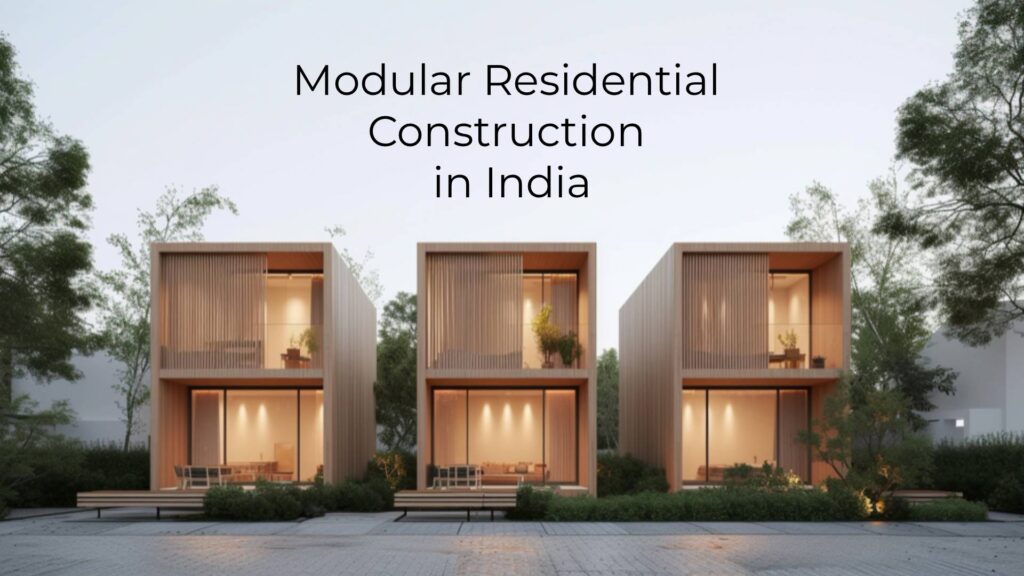
If you’ve been researching ways to build your dream home faster, smarter, and more affordably, you’ve likely come across the term modular residential construction. Once considered a niche concept in India, modular construction has rapidly evolved into a mainstream, widely-accepted approach, especially in fast-growing metros like Bangalore, Pune, Hyderabad, and Chennai.
India’s modular construction market was valued at USD 3.9 billion in 2026 and is projected to reach USD 8.3 billion by 2033, growing at a compound annual growth rate of nearly 10%. This isn’t just a trend, it’s a fundamental shift in how India builds homes.
In this comprehensive guide, we’ll walk you through everything you need to know about modular residential construction: what it is, how it works, how much it costs, what makes it different from conventional construction, and whether it’s the right fit for your home project in Bangalore.
What Is Modular Residential Construction?
Modular residential construction is a modern building method in which sections, or “modules”, of a home are manufactured in a controlled factory environment and then transported to the construction site for assembly. Unlike traditional brick-and-mortar construction, where everything is built on-site from the ground up, modular construction separates fabrication from assembly.
Each module is a self-contained unit, typically a room or a functional section of the home, built to precise measurements and specifications. Once delivered to your plot, these modules are assembled, connected to utilities, and finished to create a complete, liveable home.
Importantly, modular homes in India must comply with the same National Building Code (NBC) standards as conventionally built homes. The modules use the same materials, concrete, steel, timber, and meet identical safety, structural, and occupancy requirements. The difference lies in the process, not the quality.
There are two broad categories of modular residential construction:
Permanent Modular Construction (PMC): These are designed as long-term structures, indistinguishable from traditionally built homes once completed. Permanent modular homes account for the majority (over 85%) of modular builds in India.
Relocatable or Temporary Modular Structures: These are movable structures built for temporary use, site offices, portacabins, or disaster-relief shelters. They fall outside the scope of traditional residential projects.
For most homeowners in Bangalore and across urban India, permanent modular construction is the relevant category.
How Does the Modular Construction Process Work?
Understanding the step-by-step process helps demystify why modular construction is faster and more efficient than conventional methods.
Step 1, Design and Engineering
The process begins with detailed architectural planning, just like any home project. Structural engineers and architects design the home with modular specifications in mind. BIM (Building Information Modelling) technology is often used to create precise 3D models that guide factory fabrication.
Step 2, Site Preparation
While the modules are being manufactured at the factory, your plot is simultaneously prepared, foundation work, utility connections, and soil testing are carried out. This parallel processing is one of the biggest time-saving advantages of modular construction.
Step 3, Factory Fabrication
Modules are built under controlled indoor conditions. Factory settings allow for tighter quality control, reduced weather-related delays, and minimal material wastage. Electrical wiring, plumbing, insulation, and interior finishes can all be installed inside the factory.
Step 4, Transportation and Assembly
Completed modules are transported to the site and assembled using cranes and skilled crews. Assembly is typically far quicker than on-site construction.
Step 5, Final Finishing and Handover
Once assembled, the structure is connected to utilities, finished with interiors and exteriors, and inspected before handover.
The total construction timeline for a modular home can be 30–50% shorter than a conventional build of the same size.
Modular vs. Traditional Residential Construction: A Clear Comparison
This is the question every homeowner asks. Here’s an honest comparison across the parameters that matter most to Indian homebuyers.
| Parameter | Modular Construction | Traditional Construction |
| Construction Time | 40–60% faster | Standard timeline (12–18 months typical) |
| Cost Predictability | High (factory pricing is fixed) | Variable (labour & material price fluctuations) |
| Quality Control | Controlled factory environment | Dependent on site conditions |
| Weather Delays | Minimal (indoor fabrication) | Significant during monsoons |
| Design Flexibility | Improving (3D printing & BIM) | Very high |
| Material Waste | 20–30% less than conventional | Higher site waste |
| Customisation | Moderate to high | High |
| Resale Value | Comparable to traditional | Established market perception |
The key takeaway: modular construction does not mean lower quality. In many aspects, consistency, precision, and material efficiency, it actually surpasses traditional on-site building.
Why Modular Residential Construction Is Growing So Fast in India
Several powerful forces are driving the rapid adoption of modular home construction across India.
Rapid Urbanisation
India’s urban population is expected to cross 600 million by 2031. Cities like Bangalore are growing faster than conventional construction can keep up with, creating urgent demand for faster, scalable housing solutions.
Government Push for Affordable Housing
The Pradhan Mantri Awas Yojana (PMAY) has sanctioned over 11 million homes with a focus on affordable, quality housing. Prefabricated and modular methods are increasingly favoured for their speed and cost-effectiveness in government-backed housing projects.
Technology Integration
BIM software, AI-driven design, IoT-based quality monitoring, and even 3D printing are transforming modular construction from a simple assembly process into a high-precision, tech-enabled system. Companies across India are investing heavily in manufacturing capabilities to meet demand.
Sustainability Goals
India’s Green Building Council (IGBC) targets 10 billion sq. ft. of green-certified buildings by 2026. Modular construction, with its lower material waste, reduced site disturbance, and energy-efficient fabrication, is central to meeting this goal.
Post-Pandemic Preferences
COVID-19 accelerated demand for homes with dedicated workspaces, improved ventilation, and flexible layouts. Modular construction, with its adaptable design philosophy, aligns well with these evolving lifestyle preferences.
For Bangalore specifically, the modular construction sector is forecast to grow at a 9.88% CAGR through 2030, the fastest among major Indian cities.
Modular Residential Construction Cost in India
Cost is typically the first concern for any homeowner. Here’s a realistic view of modular construction pricing in the Indian context.
General Cost Range
Modular residential construction in India can range from ₹1,500 to ₹3,500 per square foot, depending on the complexity of the design, the quality of materials, the level of interior finishing, and the city. In Bangalore, a mid-range modular home typically falls in the ₹1,800–₹2,800/sq. ft. range.
Where Modular Saves Money
Reduced labour costs, fewer weather-related delays, lower material waste (factories optimise usage), and shorter construction timelines (which reduce financing costs) all contribute to overall cost savings. Studies suggest modular construction can offer 10–20% cost advantages over conventional builds of similar specification.
Where Costs Can Be Higher
Initial module fabrication and transportation logistics can add to upfront costs. In remote locations, transportation of heavy modules may require significant investment.
Hidden Cost Factors to Watch
Site accessibility (for crane and transport), soil conditions, foundation type, and municipal approval processes all affect the final cost. Getting a detailed, transparent cost estimate before committing to a builder is essential.
At CosmicNest, our Construction Estimation Service is designed to give Bangalore homeowners a precise, no-hidden-charges cost breakdown, covering materials, labour, logistics, and timelines.
Types of Modular Construction Systems Used in Indian Residential Projects
Not all modular construction systems are the same. Here are the main types used in Indian residential projects:
Volumetric / 3D Modular Systems
Entire three-dimensional units (rooms or sections) are factory-built and stacked or connected on-site. This is the most common form of permanent modular construction for homes.
Panelised Systems
Pre-fabricated flat panels (walls, floors, roofs) are manufactured and assembled on-site. These offer more flexibility in layout compared to volumetric modules.
Hybrid Systems
Combine conventional on-site construction with factory-made modular elements. For example, the primary structure may be traditional, while bathrooms, kitchens, or specific rooms are pre-fabricated modules.
Precast Concrete Systems
Concrete elements like slabs, columns, and beams are cast in factories and assembled on-site. Common in large residential complexes and apartment buildings across Bangalore.
Choosing the right system depends on your plot size, design vision, budget, and local regulations. A professional construction partner helps you navigate these decisions.
Advantages of Modular Residential Construction for Bangalore Homeowners
Here’s why modular home construction deserves serious consideration if you’re building in Bangalore:
Faster Move-In Timelines
Parallel site preparation and factory fabrication can cut construction time by up to 50%. For a city where plot possession to occupancy typically takes 18+ months conventionally, this is a significant benefit.
Consistency and Quality
Factory production means every joint, fitting, and finish is built to standardised tolerances. Human error and on-site variability are dramatically reduced.
Monsoon-Proof Construction
Bangalore’s heavy monsoon season often stalls outdoor construction for weeks. Since the bulk of modular fabrication happens indoors, weather disruptions are minimised.
Eco-Friendly Building
Modular construction generates 20–30% less construction waste. Factory processes allow for better material management and even the recycling of offcuts.
Budget Certainty
Factory pricing is largely fixed. Unlike traditional construction, where material price hikes or labour shortages can blow your budget, modular construction offers higher cost predictability.
Vastu and Design Flexibility
Modern modular design systems allow for Vastu-compliant layouts, open floor plans, high ceilings, and custom room configurations. The days of cookie-cutter modular homes are well behind us.
Challenges and Limitations: What You Should Know
Modular construction is not without its challenges. Here’s an honest look at the limitations:
Perception and Acceptance
Many Indian homebuyers still associate modular or prefab construction with temporary structures. This perception is changing, but it remains a factor in some markets.
Design Constraints
Very complex, intricate architectural designs may be difficult to fully achieve through standard modular systems. However, hybrid approaches are increasingly solving this problem.
Transportation Logistics
Narrow roads, low bridges, or restricted access to your plot can complicate or increase the cost of transporting modules. This is more relevant in densely built urban areas or remote sites.
Skilled Assembly Teams
Module assembly requires trained, specialised crews. The quality of on-site assembly is as important as factory quality. Choosing an experienced residential construction partner is critical.
Regulatory Approvals
While the National Building Code now accommodates modular buildings, local municipal approvals, like BBMP sanctions in Bangalore, still require careful documentation and navigation. Working with experienced builders who handle approvals in-house is essential.
At CosmicNest, our Residential Construction service covers end-to-end project management, including BBMP approval assistance, so you never have to navigate bureaucracy alone.
How to Integrate Modular Elements into Your Conventional Home Build
You don’t have to choose between fully modular or fully conventional. A growing number of Bangalore homeowners are adopting a hybrid approach, using modular elements for specific parts of the home to maximise benefits.
Popular modular integrations include pre-fabricated bathroom pods (fitted with plumbing, tiles, and fixtures in the factory), modular kitchen units, prefabricated staircase elements, and precast concrete roofing slabs. These elements can be seamlessly integrated into otherwise conventionally built homes, giving you the speed and quality benefits of modular construction where it matters most.
Our Residential Interior Design service at CosmicNest specialises in modular kitchens, wardrobes, and interior finishing that complement both conventional and modular home structures.
Is Modular Residential Construction Right for You?
Modular construction is an excellent choice if:
- You want a faster build timeline and quicker occupancy
- You’re building on a clearly accessible plot with good road access
- Your design requirements are modern and flexible rather than highly intricate
- You want better cost predictability and fewer on-site delays
- You’re concerned about sustainable, low-waste construction
It may be less ideal if:
- Your plot has very restricted site access for large vehicles or cranes
- Your design involves highly complex architectural features
- Local regulatory approvals in your area are slow to adopt modular specifications
Still unsure? The best starting point is a professional site assessment and consultation. Our team at CosmicNest provides free initial consultations for homeowners in Bangalore, evaluating your site, budget, and design requirements to recommend the best construction approach.
CosmicNest’s Approach to Modern Residential Construction in Bangalore
At CosmicNest, we are a trusted residential construction company based in Bangalore with over 130 completed projects and more than a decade of experience under the Chowdeshwaris Ratna Group (founded 2012). Our expertise spans conventional residential construction, hybrid modular approaches, interior execution, and post-construction maintenance.
Whether you’re interested in exploring modular construction methods or prefer a traditional approach with modern project management, our team brings the same commitment to quality, transparency, and timely delivery to every project.
Our comprehensive services include:
- Residential Construction, Full home construction from foundation to handover, with BBMP approval support
- Residential Interior Design & Execution, Modular kitchens, wardrobes, flooring, false ceilings, and complete interior finishing
- Project Maintenance Services, Waterproofing, repairs, and preventive maintenance post-completion
- Construction Estimation, Transparent cost breakdowns before you commit
We build across Bangalore, from BSK and Uttarahalli to Whitefield, Sarjapur, and beyond, and we’re always happy to visit your site for an initial assessment.
Frequently Asked Questions About Modular Residential Construction
1. What is modular residential construction?
Modular residential construction is a building method where sections (modules) of a home are manufactured in a factory under controlled conditions, then transported to the site and assembled. It uses the same materials and meets the same building codes as conventional construction, but is typically faster and more efficient.
2. Is modular construction cheaper than traditional construction in India?
Modular construction can be 10–20% more cost-effective than traditional methods due to reduced labour costs, lower material waste, and shorter timelines. However, upfront fabrication and transport costs can be higher. The final cost depends on design complexity, materials, and location. In Bangalore, modular construction typically ranges from ₹1,800 to ₹2,800 per sq. ft.
3. How long does modular home construction take in India?
Modular construction is typically 30–50% faster than conventional builds. A home that would take 18 months conventionally may be completed in 9–12 months using modular methods, thanks to parallel site preparation and factory fabrication.
4. Are modular homes as durable and strong as traditionally built homes?
Yes. Modular homes must comply with India’s National Building Code (NBC) and use the same structural materials, concrete, steel, engineered timber, as conventional homes. Factory quality control often results in more consistent build quality than on-site construction.
5. Can I get a modular home built in Bangalore?
Absolutely. Bangalore is one of the fastest-growing markets for modular and prefab construction in India, forecast to grow at 9.88% CAGR through 2030. Several residential builders, including CosmicNest, offer construction services that incorporate modular elements for Bangalore homeowners.
6. Do modular homes require BBMP approval in Bangalore?
Yes. Like any residential construction in Bangalore, modular homes require BBMP plan approval and relevant clearances. Experienced builders like CosmicNest handle the complete approval process on your behalf.
7. Can modular construction be Vastu-compliant?
Yes. Modern modular design systems allow for fully Vastu-compliant layouts. During the design phase, Vastu requirements are incorporated into the module specifications and floor plan before fabrication begins.
8. What is the difference between modular and prefabricated construction?
The terms are often used interchangeably. Technically, “prefabricated” refers to any component made off-site (including panels, beams, and slabs), while “modular” specifically refers to three-dimensional, volumetric units. All modular construction is prefabricated, but not all prefabricated construction is modular.
9. Is modular construction suitable for independent houses (villas) in Bangalore?
Yes. Modular construction is increasingly used for independent houses, villas, and row houses in Bangalore. Hybrid approaches, combining conventional structure with modular interior elements like kitchens, bathrooms, and wardrobes, are especially popular.
10. How do I get started with modular residential construction in Bangalore?
Start with a site assessment and consultation with an experienced residential construction company. CosmicNest offers free consultations for Bangalore homeowners, contact us here to begin your home-building journey.
Additional Resources
- CosmicNest Residential Construction Services
- Residential Interior Design & Execution
- Construction Cost Estimation Service
- Project Maintenance & Post-Construction Services
- View Our Completed Projects Portfolio
- Read More Construction Insights on Our Blog
CosmicNest is a trusted residential construction company in Bangalore, with 130+ completed projects across the city.